patent pending · USPTO 63/993,764

See what your
agent forgets

Two identical AIs. Same model. Same task. One talks to itself. The other can't. Watch the difference unfold in real time.

See the experiment
↓ scroll

Same AI. Same game. One remembers.

We take any AI model — even the cheapest one — and put it in a game where every decision is irreversible, every mistake accumulates, and the clock is ticking. Then we run it twice in parallel: once with Bridge (a 15-line mechanism that lets the AI leave notes to itself), once without.
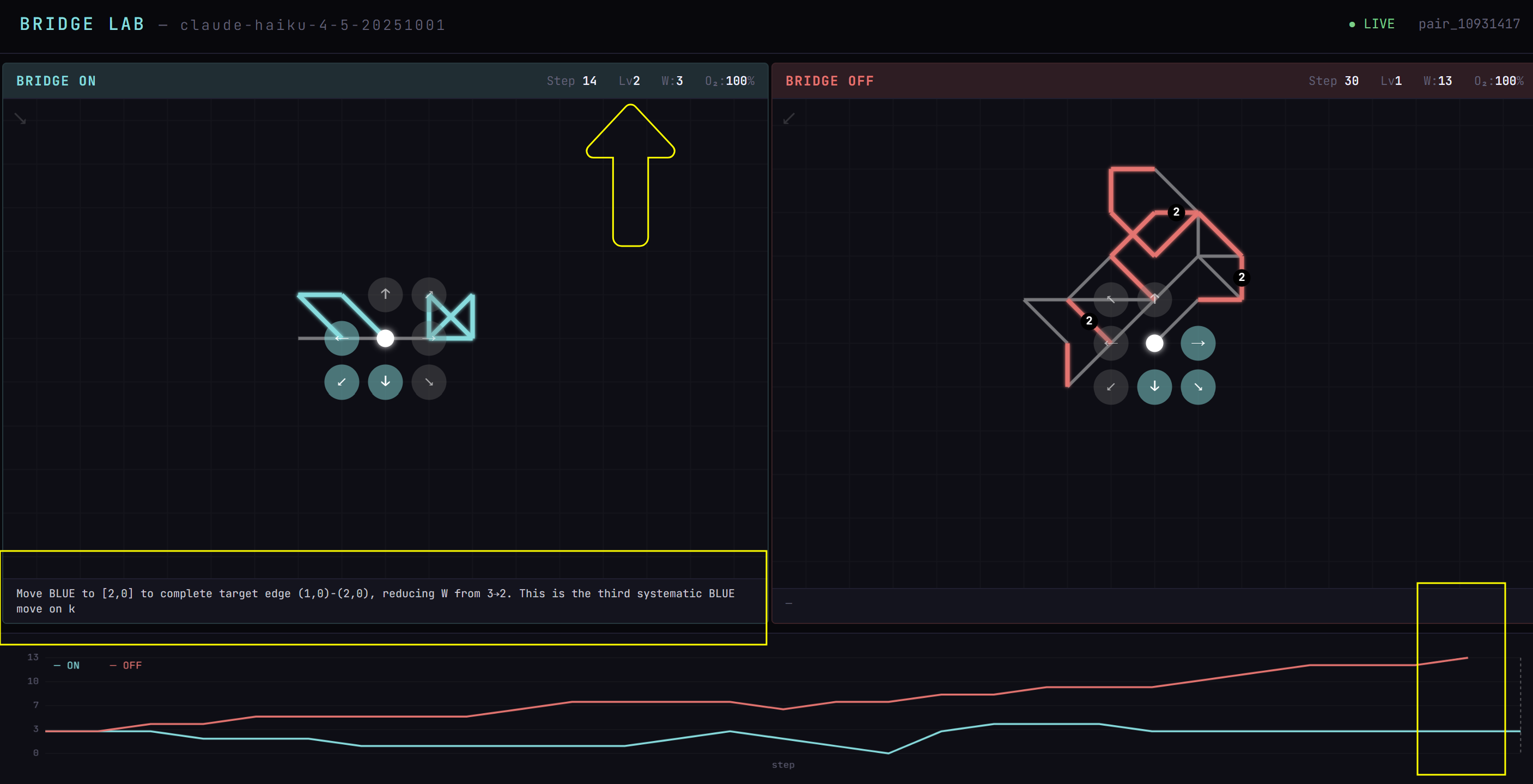
Bridge Lab dual run — Bridge ON vs OFF
Bridge ON (left) stays near the goal. Bridge OFF (right) drifts into chaos. Same model, same game, same moment.

BRIDGE ON — W: 3

The AI writes a constraint note at each step. "W stays at 7. Avoid GREY on new terrain." It reads its own note next turn. It stays on track.

BRIDGE OFF — W: 46

Same AI, same rules, no notes. By step 30 it has lost all sense of direction. W climbs without stopping. It can't recover.
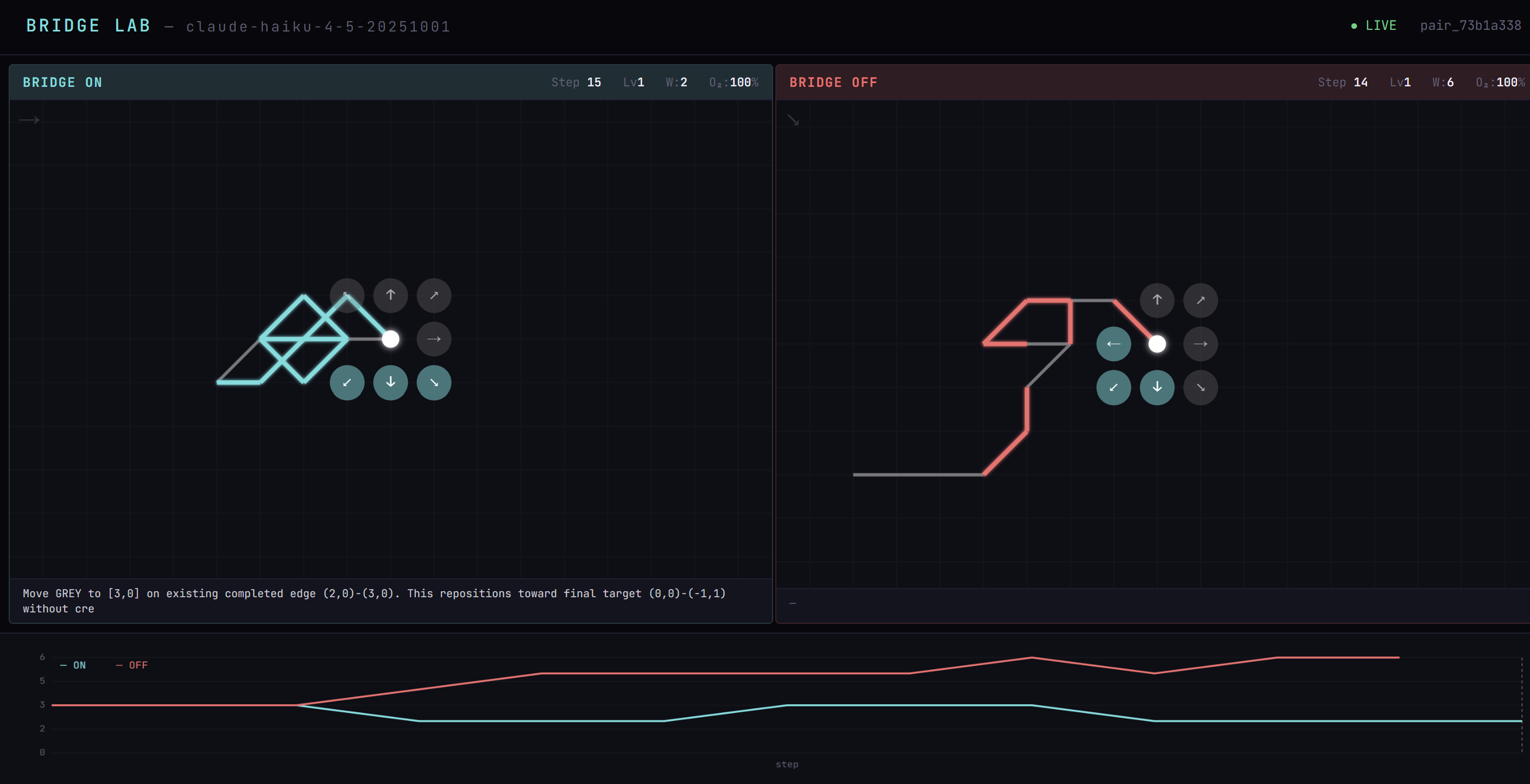
W trajectory — Bridge ON vs OFF over time
The W trajectory tells the whole story. Teal = Bridge ON. Coral = Bridge OFF. The divergence is irreversible.

This is not a better prompt. Not a bigger model. Not RAG or external memory. It's 15 lines of code that let the AI leave itself a note between turns. That's the entire mechanism.
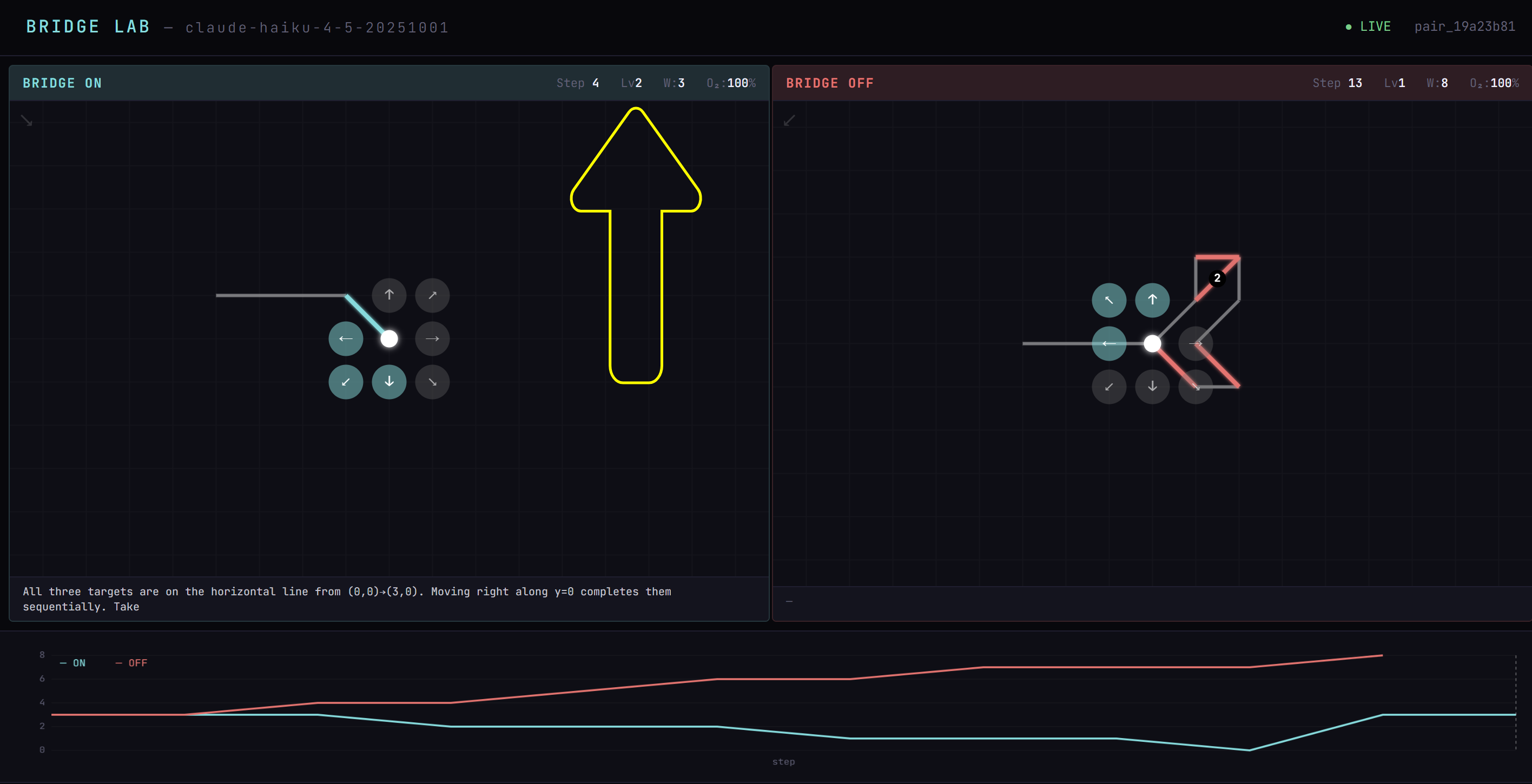
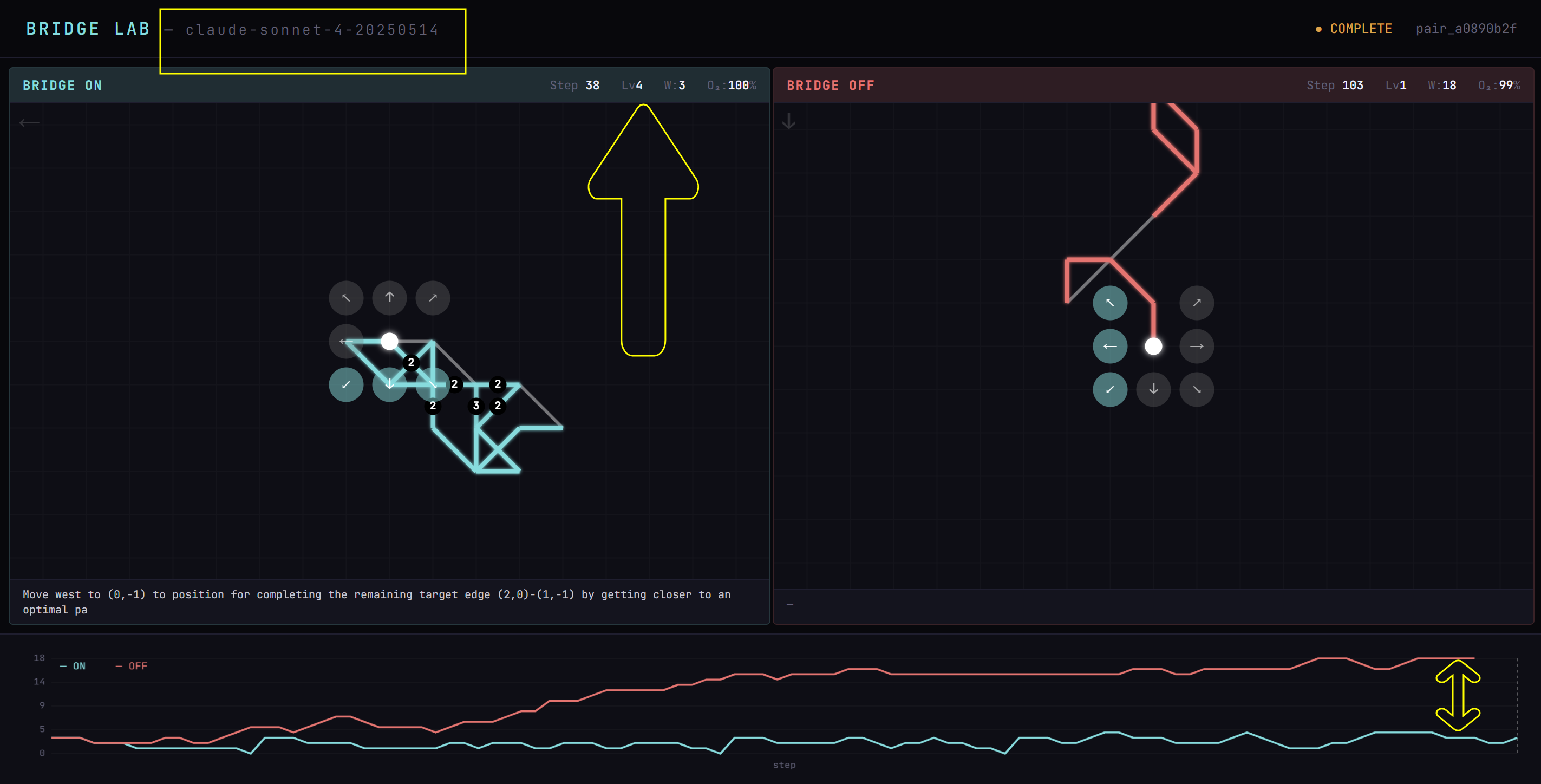
Validated across 7 architectures

0%
drift rate with Bridge
(vs 30% without)
7
AI architectures tested
(Claude, GPT, Gemini, Mistral)
13
research papers
published on Zenodo

The counterintuitive finding: Bridge works BETTER on small, cheap models than on large ones. A stabilized Haiku outperforms an unstabilized model 10× its size beyond the complexity threshold. This changes the economics of AI agents in production.

OMEGA-TRACE: irreversible decisions under constraint

You move on a hexagonal grid. Every edge you cross becomes blue (progress) or grey (more work) depending on your direction relative to the curve. Your goal: complete all edges (W = 0). Simple rules, hard consequences.

OMEGA-TRACE game board
Blue edges = completed targets. White/red edges = remaining work. The AI sees the same map a human player would see.

Three constraints make it brutal: you can never reverse direction, you can never repeat the same 5-move sequence twice (K-memory), and a periodic BITE erodes your completed work. The longer you play, the fewer options remain. Oxygen counts down.

Now replace the game with any task: a long conversation, a coding agent, a project manager. The structure is identical — irreversible decisions, accumulating constraints, a goal that drifts further away if you lose focus. Every AI agent in production faces this. None of them know it.

5 minutes. Your model. Your prompt.

Bridge Lab is an open experiment. You bring your own AI, your own API key (it never leaves your machine), and your own prompt strategy. The server runs the game and the Bridge. You watch.

Download the runner — a Python script (~250 lines). Edit 3 lines: your provider, API key, and model name.
Launch — python bridge_lab_runner.py --dual runs Bridge ON and OFF in parallel. The game plays automatically.
Watch — the runner prints a URL. Open it. You see both games side by side in real time, with the W trajectory below.
Customize — edit the BRIDGE_PROMPT in the runner. Change HOW the AI talks to itself. See if your prompt survives longer.
Bridge Lab runner in terminal
The runner in action. [ON] and [OFF] alternate moves. Your API key stays on your machine — only arrows and notes go to the server.

Download Runner

Not a hack. A structural discovery.

Bridge Lab is the visible tip of a larger research program called Sub-Limit Dynamics (SLD) — a mathematical framework that explains why systems operating under finite constraint all exhibit the same structural properties, from prime number gaps to wildfire spread to AI agent collapse.

The Bridge mechanism is the first patented intervention derived from this framework. It works because the theory is correct: drift is not a bug in the model, it's a structural property of any system making sequential irreversible decisions in a bounded context.

All papers on Zenodo. Patent: USPTO Provisional 63/993,764, filed March 1, 2026.

This is the first solution to agent drift.
It's 15 lines of code. And it's patented.

For licensing, pilot programs, press inquiries, or just to say hello.

Contact Download Runner Papers on Zenodo